
Arenado's modest on-field projection entering his age-35 season plus a no-trade clause meant that there were minimal expectations regarding the Cardinals' ability to reel in a return of significant value.
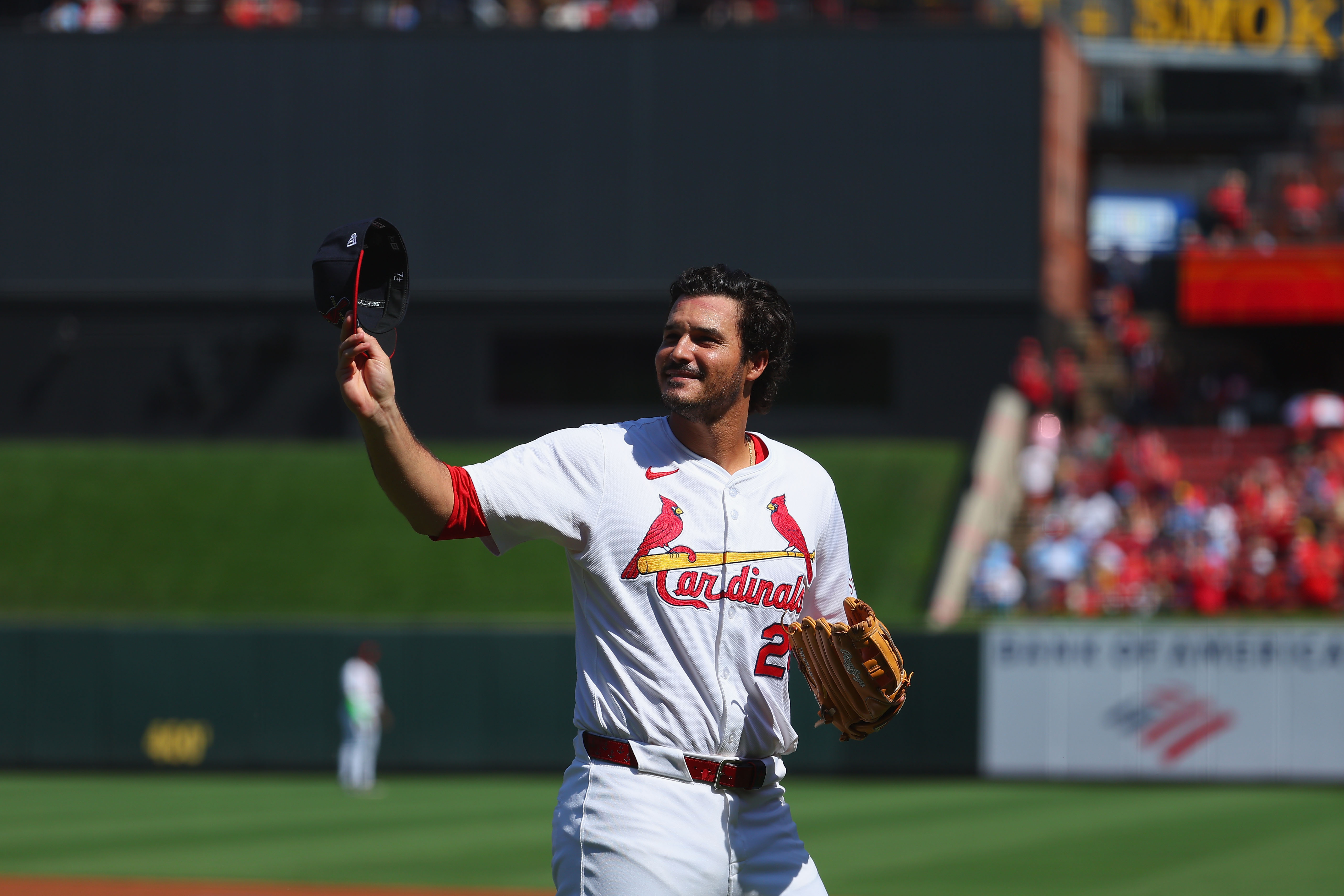
The St. Louis Cardinals continued their offseason of offloading on Tuesday, completing a deal with the Arizona Diamondbacks to send highly accomplished third baseman Nolan Arenado to the desert in exchange for right-hander Jack Martinez, Arizona’s eighth round pick last summer.
At first glance, seeing a possible future Hall of Famer swapped for a minor-league arm who has yet to even throw a professional pitch looks jarringly imbalanced, but this trade is the product of a multitude of factors hovering over the names involved. It is the end result of a saga dating back to last offseason in which the Cardinals sought to rid themselves of Arenado’s onerous contract while also affording the veteran the opportunity to play for a contending team elsewhere while St. Louis shifts its organizational focus to the future rather than going all out to chase a championship in the short term. And while Arenado’s name still carries significant weight league-wide as one of the most decorated position players of his generation, it’s impossible to ignore the degree to which his performance has declined in recent years, which heavily informs the nature of the deal.
Arenado was an all-around force early in his career with the Colorado Rockies, compiling gaudy numbers at the plate playing half his games at Coors Field while playing generational defense at third base, earning a Gold Glove in all eight years of his Denver tenure. Traded to St. Louis just two seasons into the eight-year, $260 million extension he signed with Colorado before the 2019 season, Arenado quickly proved his superstar stats weren’t merely the product of the hitter-friendly high-altitude in Colorado, delivering a spectacular 2022 season that saw him finish third in NL MVP voting. He continued to shine early on in his third season as a Cardinal in 2023, making his eighth career All-Star Game, but his production plummeted in the second half of that season, and has trended in the wrong direction ever since. His once otherworldly glove now merely rates as good, and his bat has sunk to slightly below league-average: Among 120 hitters with at least 1,000 plate appearances over the past two seasons, Arenado’s 95 wRC+ ranks 107th.
Most crucially, Arenado held significant power within these negotiations, as the no-trade clause in his contract enabled him to green-light his destination once the Cardinals were able to find a willing trade partner. Arenado famously rejected an agreed-upon trade to the Astros during last offseason in hopes that a different suitor would emerge before the 2025 season, but that never happened, nor did a trade come to fruition at last year’s trade deadline while Arenado was in the midst of his worst season as a big leaguer. Nevertheless, Arenado and the Cardinals entered this offseason once again steadfast on finding a trade fit so both sides could move on, recognizing that moving the $41M owed to Arenado of the next two seasons would be difficult considering his recent performance.
[Get more Diamondbacks news: Arizona team feed]
As such, Arenado’s modest on-field projection entering his age-35 season plus the fact that he still wielded a no-trade clause that enabled him to largely dictate his destination meant that there were minimal expectations regarding the Cardinals’ ability to reel in a return of significant value. That Martinez is the only player Arizona had to part with and that St. Louis is covering $31M of the $42M owed to Arenado over the next two seasons fully validates those low expectations.
The D-Backs are a team that has spent much of the winter involved more in juicy rumors than actual transactional activity. Save the resigning of backup catcher James McCann and a pair of free agent pitching additions in December — the return of longtime rotation mainstay Merrill Kelly after he was traded to Texas at last year’s deadline, plus Michael Soroka — the D-backs have made far more headlines for moves they were reportedly contemplating rather than moves they’ve made.
First, it was the possibility that the Snakes would be willing to trade star second baseman Ketel Marte, a delicate gambit in theory intended to leverage their strong position player depth by dealing the ultra-valuable Marte in exchange for sorely-needed young pitching. Meanwhile, there was also consistent reporting that the D-backs were expressing interest in free agent third baseman Alex Bregman, perhaps as a creative avenue to replace Marte in the event they did trade him and his salary (and production) elsewhere. Ultimately, general manager Mike Hazen determined last week that Marte was no longer available in trade discussions. A few days later, Bregman agreed to a deal with the Chicago Cubs, rendering both intriguing scenarios irrelevant despite weeks of speculation.
Exactly how serious Arizona was in its pursuit of Bregman is unclear, but those rumors did suggest the club viewed third base as an area of need. That’s not an enormous surprise considering the Snakes had dealt away Eugenio Suarez at last year’s trade deadline, but it also seemed reasonable to look at Arizona’s depth chart and view this as a chance finally give the keys to 23-year-old Jordan Lawlar, the top infield prospect who has consistently raked in the minors but has yet prove himself in the majors, in part due to the series of injuries that has limited his availability. A sensible path for Arizona could have been to roll with Lawlar at third base and focus its offseason strategy and spending almost exclusively on adding much-needed pitching.
Evidently, Arizona still viewed Arenado for what will only cost $11M over the next two seasons as a worthy upgrade. It’s more likely that says more the degree to which even this diminished version of Arenado could be a bargain at that price than Arizona’s confidence in Lawlar long-term, but it is an interesting roster-construction choice nonetheless. Just as we just saw with the Cubs signing Bregman despite the presence of a talented young infielder in Matt Shaw, contending teams are often willing to add veteran certainty even if it costs young, less-proven players playing time. That’s not to say Arenado should be expected to make remotely the same level of impact as Bregman in Chicago, but it’s also not hard to imagine Arizona liking the idea of adding a well-respected veteran like Arenado to a position player group that skews quite young. And if he can even provide some stability at third base more than any semblance of star power he still has left, that could play a meaningful role in boosting Arizona’s chances of staying afloat in what is expected to be another heated National League postseason race.
Speaking of the Snakes chasing a return to the postseason, If there is something still lacking on Arenado’s loaded résumé, it’s any semblance of memorable postseason success. Arenado has made just four trips to the postseason in his 13 years in the majors — two with Colorado and two with St. Louis — but has never advanced beyond the division series. He hasn’t exactly shined in those limited opportunities — he has just five hits in 33 career postseason at-bats — but in general, his lack of October experience obviously has far less to do with his own efforts and more about the teams he has been a part of.
With that in mind, as his career winds down, it’s understandable that Arenado would prioritize a club with ambitions of contending when surveying the landscape of possible trade destinations. Of course, it wasn’t entirely up to Arenado, as a team that what he was looking for still needed to step up and view Arenado as a worthwhile addition. Acknowledging that Arenado likely didn’t have a wealth of contending teams desperate for a player of his current caliber, Arizona is a pretty solid landing spot, all things considered.
Category: General Sports


