
This winter, Italy will host athletes from around the world at the Milano Cortina 2026 Winter Olympics. Here’s the lowdown on what’s new in the host resorts, what to see and where to ski in the footsteps of champions.
This article was produced by National Geographic Traveller (UK).
Faster, Higher, Stronger, Together. Not the title of a hitherto unreleased Daft Punk remix, but the new Olympic motto. Announced with great fanfare shortly before the last Winter Games, the addition of the word ‘Together’ to the century-old Latin formulation Citius, Altius, Fortius was meant to emphasise the International Olympic Committee’s commitment to public participation.
Of course, for operational and security reasons, the ski slopes hosting the upcoming Milano Cortina Winter Olympics will be largely off limits during the Games itself. But the lead-up and immediate aftermath of the Olympics are great times for the skiing public to visit. An expanded Verona Airport will mean more flight options. New roads will cut transfer times. And new investments in lifts, snow cannons and grooming machines will ensure the pistes are in tip-top shape.
To avoid costly white elephants and keep the environmental impact down, the Italian organisers are reusing and revamping existing facilities wherever possible. This has meant spreading the events across eight different destinations and more than 22,000sq km, making Milano Cortina the most geographically diverse Winter Games ever.
As well as Milan (which will host the ice skating and hockey) and Verona (which will host the closing ceremony in its 2,000-year-old Roman amphitheatre), there are six ski resorts staging ‘on snow’ events. The sheer variety of options for enthusiasts who want to ski the Olympic slopes themselves is staggering. Most of the host resorts are already fully booked for the Olympics (6-22 February) and the Paralympics (6-15 March). But outside those weeks, prices are more or less normal.
Of course not all of us can jump as high as snowboarder Mia Brookes or ski as fast as slalom racer Dave Ryding. But if you’re feeling inspired and want to follow in the footsteps of these Team GB medal hopefuls, read on.

Antholz/Anterselva
Set in a steep-sided valley in the German-speaking South Tyrol region, Antholz/Anterselva (which is always referred to by both its German and Italian names in official Olympic literature) is largely unknown among British skiers. Unless, of course, they happen to be big fans of biathlon. Originally designed as a test of winter hunting skills, this idiosyncratic sport, which combines cross-country skiing and rifle shooting, has been contested in a dedicated arena here since the 1970s.
The resort is made up of three main villages — lower, middle and upper Antholz — spread ribbon-like along the road that runs up the valley. While it might get crowded during the Games, it’s normally a quiet, sleepy place. Think wooden chalets with colourful, gentian-filled balcony boxes clustered around traditional, Tyrolean churches.
The biathlon arena is located near upper Antholz, but there are cross-country skiing tracks everywhere — more than 60km of them in total. Aside from one button lift there are no downhill skiing facilities in the valley (although you can catch a bus to nearby Kronplatz). But if you like Nordic skiing, and particularly if you fancy combining it with target shooting, there’s no better place to come.
Ski it yourself: SnowTrex offers seven nights half board at Sporthotel Wildgall in upper Antholz from £593 per person, based on travel 28 February to 8 March 2026.

Bormio
A resort town for over 2,000 years, Bormio saw Romans flocking here to bathe in its natural hot springs — including the author and admiral Pliny the Elder — and, centuries later, Leonardo da Vinci. But more recently, Bormio’s reputation has rested on its status as a world-class skiing spot.
Its Stelvio Slope, which will host the men’s Olympic downhill, super G and giant slalom races, is a perilously steep black, with a maximum gradient of 73%, and 1,000m of vertical drop. It’s famously one of the toughest and most technical stops on the World Cup circuit each year. While mere mortals can ski it outside of competitions, it’s not for the faint-hearted.
Thankfully, that’s not the only thing Bormio has to offer. There are plenty of easier blue- and red-graded pistes among its 50km of slopes. The snow-sure ski area, which tops out at over 3,000m, also has plenty of options for those who love venturing off-piste. In fact, Bormio has been chosen to host the first-ever Olympic ski mountaineering contest. Watch out for Team GB’s Iain Innes, who’ll be among those skinning uphill on touring skis, using technical mountaineering skills and choosing a path to ski down.
Ski it yourself:IgluSki offers seven nights self-catered accommodation at Santa Lucia Apartments for £237 per person, based on travel 6-14 January 2026.
Cortina d’Ampezzo
A long-favoured winter getaway for wealthy Italians and visiting luminaries, Cortina hosted Hemingway in the 1920s, while Frank Sinatra and Sophia Loren followed suit in the post-war period. Then in 1981 Roger Moore’s James Bond escaped evil henchmen by racing down the resort’s bobsleigh track. Cortina has Olympic pedigree, too. Both its ski jump and bobsleigh track were built for the 1956 Winter Games. And, as the countdown clock in the main square ticks towards the first events of Milano Cortina 2026, the buzz in town is palpable.
The resort’s Olympia di Tofane piste will host bobsleigh, Para Alpine skiing and women’s Olympic Alpine skiing events, while its ice arena will welcome the curling. This means some of the most talked-about athletes of the games will be competing here: US slalom superstar Mikaela Shiffrin, local hero Sofia Goggia and unstoppable veteran Lindsey Vonn, who’s aiming to make an Olympic comeback at the age of 40, after years away from the sport. In the Para snowboard events, watch out for Team GB’s Ollie Hill, who won bronze in the banked slalom at Beijing 2022.
Ski it yourself: Heidi offers seven nights B&B at Hotel Olimpia, with flights and transfers included, for £1,032 per person, based on travel 10-17 January.


Livigno
Located on a remote, high-Alpine plateau near the Swiss border, Livigno has always felt somewhat removed from the rest of Italy. Its skiing and snowboarding culture has developed separately, too, with a heavy emphasis on freestyle. The Mottolino SnowPark, which will host the freeskiing and snowboarding events of the Milano Cortina Games, has long been recognised as one of the best in Europe, with a perfectly shaped ‘pro line’ featuring the enormous, 19m-plus jumps that enable athletes to perform the biggest tricks.
It’s here that three of Team GB’s most likely medal contenders — slopestyle snowboarder Mia Brookes, big air skier Kirsty Muir and reigning halfpipe world champion Zoe Atkin — will be going for Olympic gold.
You don’t have to be able to spin a triple cork 2160 to make the most of this resort though. There are plenty of easy blue and red runs in Mottolino and in the Carosello area, on the opposite side of the valley. The village is high, at 1,816m above sea level, and the lifts reach up to 2,797m, meaning it’s snow sure with a long season.
As a quirk of its location, the town enjoys duty-free status, meaning everything from accommodation to apres drinks are relatively cheap and there’s a lively party scene. Here’s hoping that Team GB’s stars can give visiting fans something to celebrate.
Ski it yourself: Inghams offers seven days half board at Hotel Livigno with flights and transfers included for £1,198 per person, based on travel 7-14 March.
Predazzo
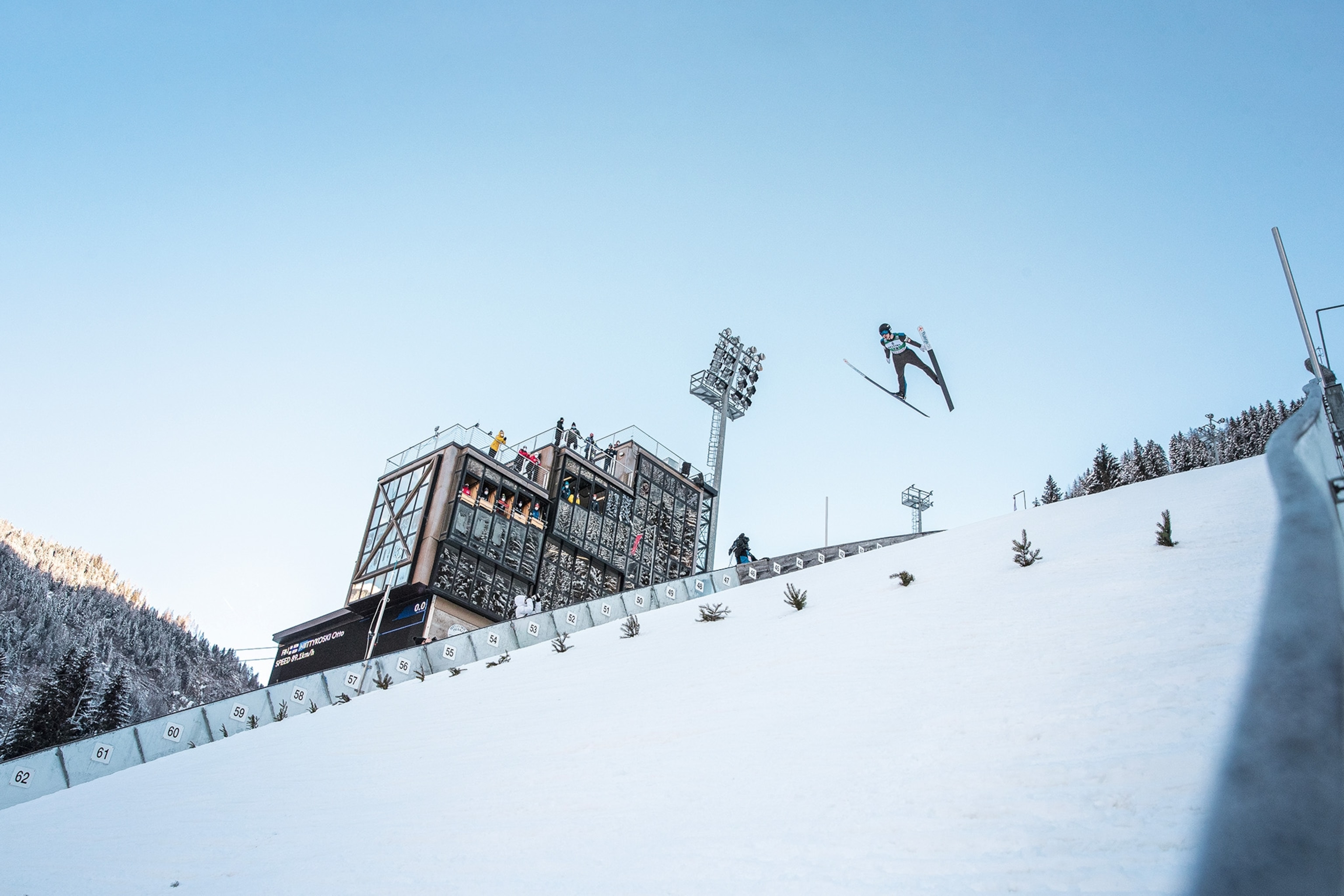
The Fiemme Valley lies north east of Trento, capital of the Italian-speaking part of the Dolomites. It’s home to several ski areas including Alpe Cermis, Latemar, Alpe Luisa and Passo Rolle, all of which can be accessed on a single Val di Fiemme lift pass (or the massive Dolomiti Superski Area pass, which grants access to 1,200km of slopes throughout the region). Predazzo, towards the valley’s upper end, is one of several villages with easy access to these slopes — and it’s also home to the massive ramps that will stage the ski jumping events at the Milano Cortina Olympics.
Work on expanding and improving the ski jumping arena finished in July; the new Large Hill jump has a K-point (the par distance that jumpers must clear) of 128m. Even if you’re visiting before or after the Games, it’s worth going to take a look just to get a sense of its sheer scale, which never really translates on TV.
Predazzo has a good selection of mid-market hotels and a family-friendly vibe. It’s also one of the less crowded Dolomiti Superski resorts. Regular ski buses connect all the aforementioned ski areas.
Ski it yourself: SnowTrex offers seven nights B&B at Hotel Villa Meli, including a six-day Val di Fiemme lift pass, for £876 per person, based on travel 1-8 March.

Tesero
Tesero sits in the centre of the Fiemme Valley, just a 10-minute drive from Predazzo, and within easy bus or driving distance from the various surrounding ski areas. Between them, Alpe Cermis, Latemar, Alpe Luisa, Passo Lavazè-Oclini and Passo Rolle offer 110km of varied, well-groomed slopes. Tesero itself, however, is famous not for Alpine skiing, but for cross-country. It hosts the Marcialonga — the ‘long march’ — a 70km mass-start cross-country race that attracts thousands of competitors, both amateurs and pros, to the village each year. Unsurprisingly, the cross-country arena in the village has been selected to host the Nordic skiing events during the Milano Cortina Olympics.
When it’s not hosting sporting events, Tesero is quiet and traditional, and while there are no Alpine ski lifts in the village itself, it’s a great place to stay if you want to ski the various resorts of the Val di Fiemme — especially around Christmas, when the locals put on a spectacular exhibition of elaborate, handcrafted nativity scenes.
Ski it yourself: Crystal Ski Holidays offers seven nights B&B at Hotel Alpuris in Cavalese (Val di Fiemme’s main town, close to Tesero, with direct lift access to Alpe Cermis) including flights and transfers for £1,032 per person, based on travel 20-27 December 2025.
Published in the Winter Sports guide, available with the December 2025 issue of National Geographic Traveller (UK).
To subscribe to National Geographic Traveller (UK) magazine click here. (Available in select countries only).
Category: General Sports


