
The NFL steps aside for no one, not even college football's playoff.
We’ve all been there: You’re at the airport, you arrive at your gate, it’s crowded and there’s nowhere to sit down. And then you see some dude spread out across half a dozen seats. He’s got his feet up in one, he’s got his bags piled over two more, he’s got his greasy takeout boxes on still more. Infuriating, right?
In this little metaphor, the airport gate is the calendar, and the seats are the days. You, my friend, are a humble sport looking for a place to spot up. And our I’ll-take-everything guy is, of course, the NFL, claiming not just the seat he needs, but the seats he wants, the seats he feels he’s entitled to, the seats that used to belong to you.
The idea that the NFL is a Sunday-and-Monday-night league is as quaint as leather helmets. The NFL claims whatever day it wants, whenever it wants, regardless of who else might like a little space. To say there’s “competition” between the NFL and literally every other American sports league is to suggest that there’s even a chance the NFL might lose … and we all know that’s not happening.
The latest league to attempt to stand in front of the oncoming NFL train: college football, which will pit two of the first four games of its still-new playoff against the might of two massive NFL divisional rivalries this Saturday. After Alabama-Oklahoma (8 p.m. ET, Friday) and Miami-Texas A&M (noon ET, Saturday) run unopposed, Tulane-Ole Miss (3:30 p.m.) and James Madison-Oregon (7:30 p.m.) have the unenviable task of trying to draw eyeballs away from Eagles-Commanders (5:00 p.m.) and Packers-Bears (8:20 p.m.).
Yeah. Good luck with all that, CFP.
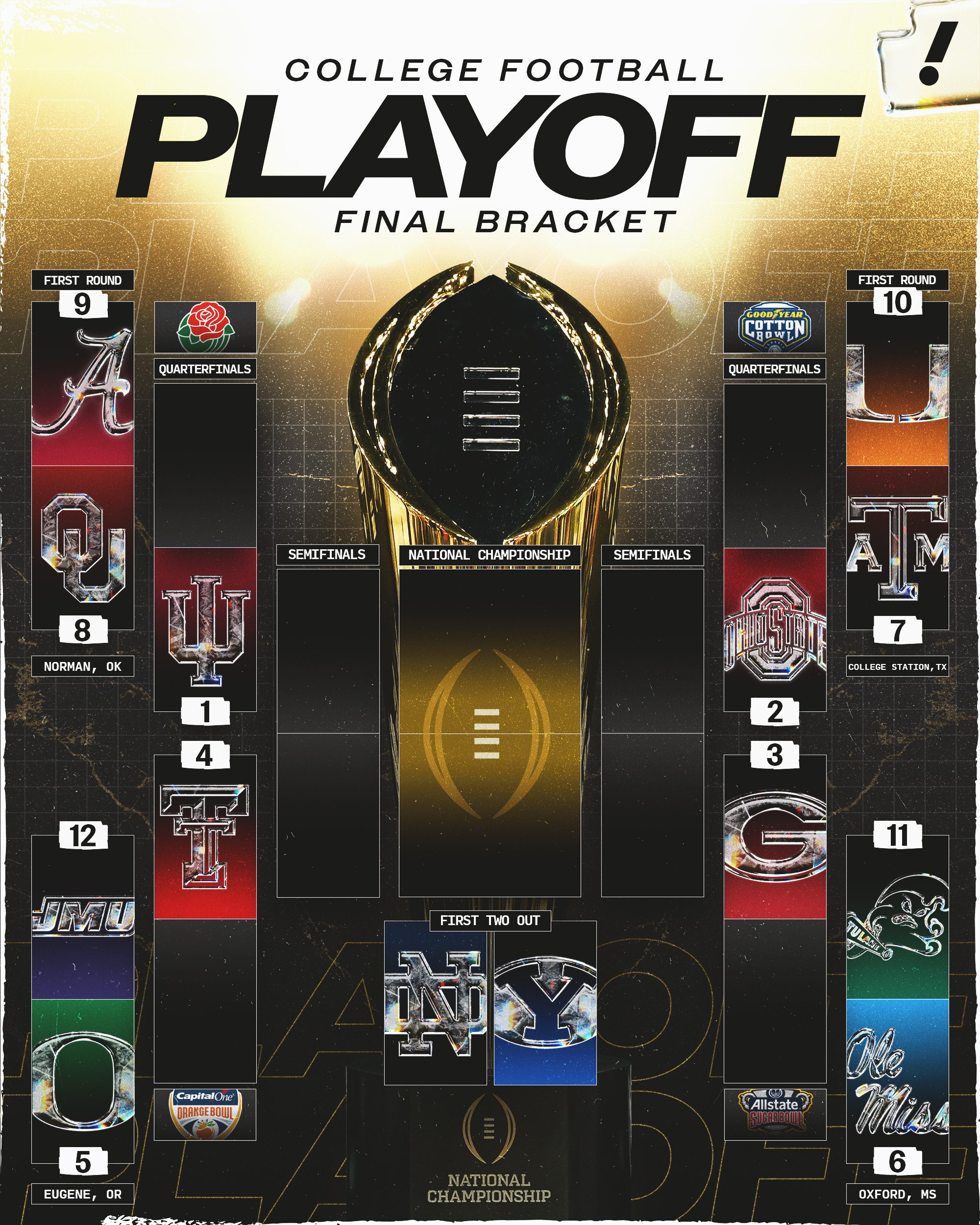
True, the NFL has been playing games on Saturdays for decades. The Sports Broadcasting Act of 1961 protected college and high school football from the NFL’s incursion, mandating that the Shield couldn’t play Saturday games before the second Saturday in December — i.e. right when college football’s regular season ends. But nobody back in 1961 foresaw the possibility of a massive multi-weekend playoff bracket.
So from the NFL’s perspective, late-December Saturdays are its territory, not college football’s … regardless of how much money ESPN pours into the bracket’s promotion. (On the other hand, you can’t suggest the NFL didn’t know exactly what it was doing by slating those massive matchups against the CFP — not when you see, say, Jets-Saints and Falcons-Cardinals also on the slate this weekend.)
This same dynamic happened last year. The CFP scheduled Indiana-Notre Dame on Friday night, Dec. 20, giving the nationally-popular Irish the same unopposed slot that Alabama-Oklahoma takes this year. Saturday saw SMU-Penn State at noon, Clemson-Texas at 4:00 and Tennessee-Ohio State at 8:00. On the same day, Texans-Chiefs kicked off at 1 p.m., and Steelers-Ravens at 4:30. (If you’re wondering why Miami-A&M, likely Saturday’s most competitive game, is kicking off at noon instead of prime time, note the shifted NFL slots.)
The results were pretty much what you’d expect. SMU-Penn State drew 6.4 million viewers, and Clemson-Texas drew 8.6 million, while Texans-Chiefs drew 15.5 million and Steelers-Ravens 15.4 million, according to Sports Media Watch. Meanwhile, the two CFP games that didn’t go head-to-head with the NFL did quite well — Tennessee-Ohio State drew 14.3 million, and Indiana-Notre Dame brought in 13.4 million.
As dispiriting as it might be to see some of your most prized properties getting absolutely waxed in the ratings, college football can take solace in the fact that the same thing happens to everybody else who challenges the NFL:
The PGA Tour has altered its entire season to make sure its playoffs — which until recently concluded in late September — finish up in August before the NFL kicks off. Potential future PGA Tour seasons, which currently start in early January, might not even begin until the Super Bowl has concluded.
NASCAR has begun running more races in the NFL season on Saturday nights. And the 2027 Daytona 500 will run a week later than its usual Presidents Day Weekend slot, because that year, because of the calendar, the Super Bowl will be muscling into that space.
The NBA has basically lost control of Christmas after decades of domination. Last year, Chiefs-Steelers and Ravens-Texans averaged about 24.2 million viewers apiece streaming on Netflix, while the NBA’s five games averaged about 5.25 million viewers. Lakers-Warriors led the way, averaging 7.76 million … the most-watched NBA regular-season game in years, but still nowhere close to even a standard NFL game.
In one of the most obvious times-have-changed signs, baseball finally gave up the fight in 2022 and moved the World Series away from Sunday nights to avoid competition with the NFL. MLB had been broadcasting Sunday night World Series games since 1947, but the competition from a routine regular-season Sunday Night Football game was just too overwhelming.
Category: General Sports


